
Table of contents

Some sounds are stimulating and soothe the mind and body. Others leave us feeling distracted, overstimulated, or tense. The type, volume, duration, and predictability of a sound all shape how we respond to it, which is why identical noise levels can feel invigorating in one setting and draining in another.
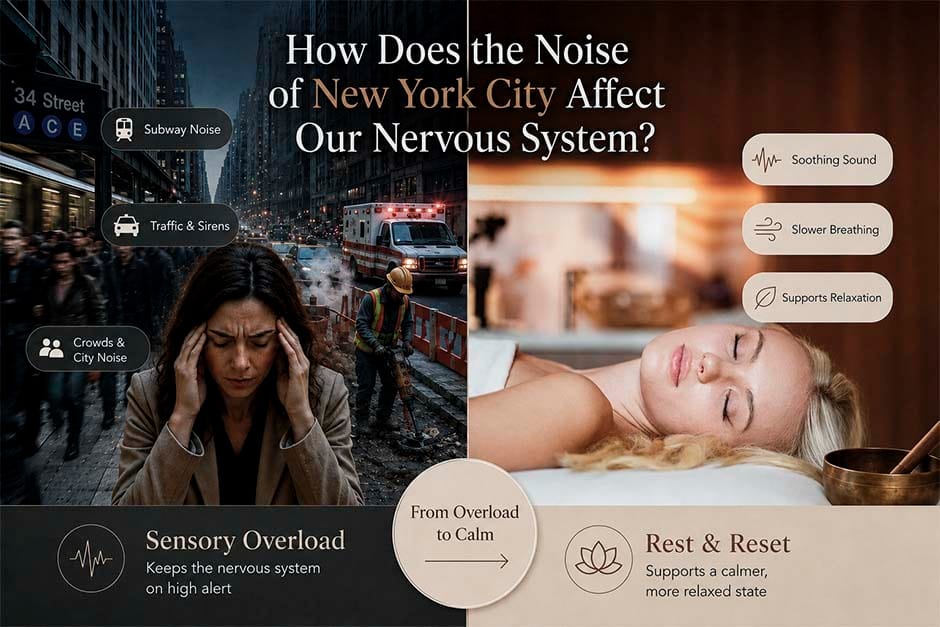
How Does the Noise of New York City Affect Our Nervous System?
New York City’s energy can be exciting, but being surrounded by noise for hours every day can also keep your nervous system on alert. Traffic horns, sirens, construction, subway noise, crowded streets, and constant conversation all add to the sensory load you carry throughout the day, and your brain keeps processing it even when you have stopped consciously noticing.
Over time, this steady stream of input can activate the body’s stress response, making it harder to relax fully. You may notice feeling more irritable, mentally tired, tense, or easily overwhelmed after hours in a busy environment. For some people, it also makes it harder to switch off at night or settle into restful sleep.
For New Yorkers who rarely get a true break from the city’s soundtrack, intentionally creating moments of quiet or introducing relaxing sounds is one simple way to give the nervous system a chance to slow down. This is one reason sound-based relaxation practices, including sound therapy, have become an appealing part of self-care routines, a deliberate counterweight to a city that rarely turns its volume down.
This is where sound therapy comes in. It presents a chance to step away from the buzz of daily life and experience the restorative effects of sound in a calm, tranquil environment.
The Physiological Mechanism of Sound Therapy and its Effects on the Body
Sound is vibration, and the human body responds to vibration in two ways at once: through hearing and through physical resonance felt directly in the tissues. Much of this runs through the vagus nerve, which helps regulate your stress response, digestion, and mood balance. Low, resonant frequencies, like the deep tone of a gong or a singing bowl, activate this nerve, shifting the body out of ‘alert’ mode and into ‘rest and repair’ mode.
Sound also affects brainwave activity. Your brain naturally shifts between faster wave patterns (linked to focus and stress) and slower ones (linked to calm and deep relaxation). Rhythmic, calming sound can gently guide the brain toward these slower, more restful patterns.
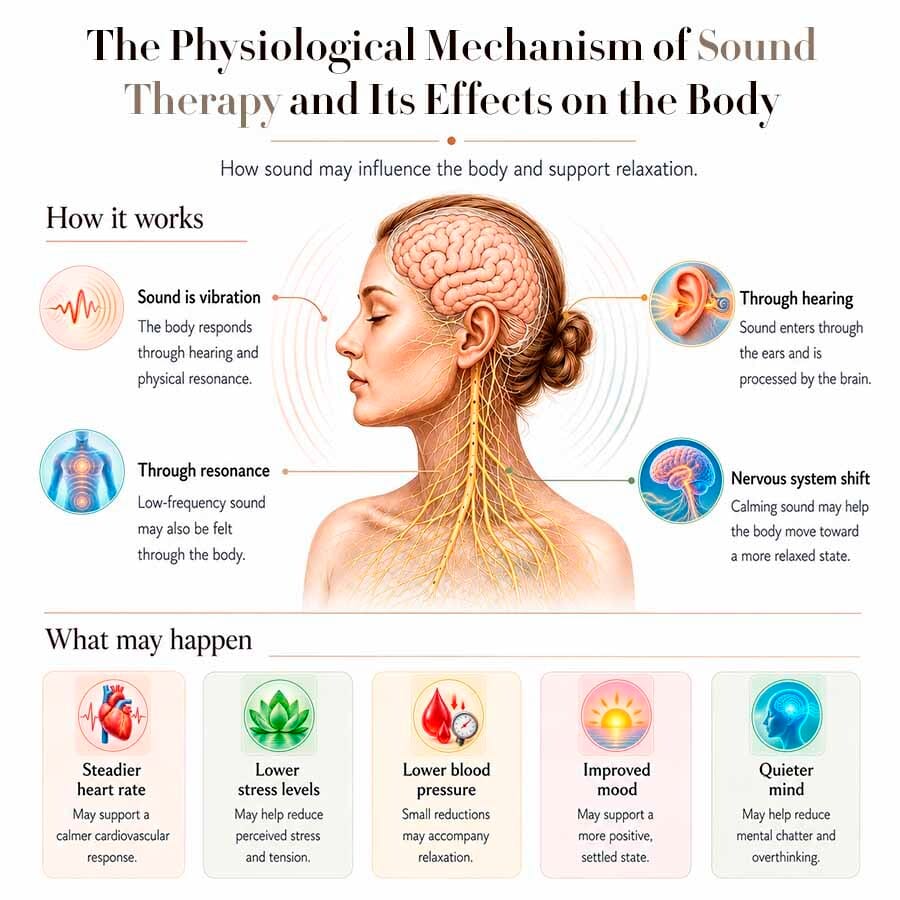
And these effects are not just felt. They can actually be measured; the same way a doctor might check with a heart monitor or blood test.
Here’s what tends to happen:
- Your heart works better – The heart rate becomes steadier and healthier.
- Stress hormones go down – Your body makes less cortisol, the hormone that builds up when you are stressed.
- Blood pressure drops a little – Another sign your body is relaxing.
- Mood-enhancing chemicals go up – Your brain releases more serotonin and dopamine, the same chemicals linked to happiness and good mood.
- Your mind gets quieter – Sound seems to calm the part of your brain that causes repetitive worrying or overthinking, which is often why your thoughts feel clearer afterward.
| Sound Therapy Modality | Physiological Mechanism | Primary Health Benefit |
|---|---|---|
| Binaural Beats / Frequency Entrainment | Plays slightly different tones in each ear; the brain perceives a third “beat” frequency, which appears to help shift brainwave activity from alert Beta (12–30 Hz) toward relaxed Alpha/Theta (4–12 Hz) states. | Reduced mental chatter, lower perceived stress, and faster recovery from a stress response. |
| Vibroacoustic Resonance | Low-frequency sound (roughly 40–150 Hz) is transmitted directly through a massage table, cushion, or resonant bowl placed on or near the body, engaging vagal tone as well as local tissue. | Physical muscular relaxation, improved local circulation, and looser, more pliable fascia. |
| Singing Bowls / Gong Baths | Layered, overtone-rich resonance (Tibetan bowls roughly 110–660 Hz, gongs spanning deep bass up past 1,000 Hz) surrounds the body, pacing breath and encouraging slower, deeper exhalation. | Downshifted sympathetic arousal, slower heart rate, higher heart rate variability, and a subjective sense of “settling.” |
At ila Only Spa, we use this soothing approach to help you unwind, and reconnect with a sense of calm. When paired with hands-on treatments, the effect goes even further, giving both body and mind a genuine reset.
What are the Health Benefits of Sound Therapy?
Research on sound therapy is still growing, but a few areas show real promise:
- Enhanced mood — Helps ease stress and anxiety, and can lower heart rate and blood pressure.
- Improved cognition — May support memory and attention with regular use.
- Pain relief — May ease how pain is perceived, with some benefit shown for conditions like fibromyalgia and chronic pain.
- Other emerging benefits — Early research also points to potential support for sleep issues like insomnia, tinnitus, and lung or respiratory conditions.
It is worth noting that this is an evolving area of research. Early studies are often small, and scientists are still working out which frequencies, durations, and formats offer the most benefit. Even so, the overall direction of the results is encouraging.
Why Sound Therapy Boosts the Effects of Physical Spa Treatments
A massage, facial, or other hands-on treatment can help release physical tension, but how at ease you feel during a treatment also depends on what is happening in your mind. If you are still thinking about work, your commute, your to-do list, or the noise of the city, it can be difficult to switch off fully, and a nervous system that has not switched off stays physically guarded, whether you are aware of it or not.
This is where sound therapy can complement a physical spa treatment. Soothing sounds can produce a more peaceful environment, encourage you to slow your breathing, and give your attention something calming to focus on rather than the distractions of everyday life.
When the mind begins to settle, it becomes easier to relax into the physical experience of a massage or other treatment.
That’s how sound therapy plays a central role in augmenting the effects of physical spa treatments:
- It helps ease muscle tension before treatment even begins – Sound therapy calms the nervous system, so muscles are less tense and on guard. When sound therapy comes before a deep-tissue or Swedish massage, this change enables the therapist to reach deeper fascia with less discomfort for you.
- It supports your skin from the inside – Stress raises cortisol, which can trigger inflammation and skin issues like acne or rosacea. Sound therapy reduces stress, so a facial can work on your skin while sound therapy addresses the root cause.
- It may make bodywork more comfortable – Sound relaxation is linked to more endorphins and less inflammation, which can make deep-tissue work or bodywork feel less intense for anyone dealing with chronic tension or soreness.
- It counters city-life fatigue – Constant noise from traffic, subways, and city life keeps your nervous system on edge. Sound therapy gives it something calm to focus on instead, helping you fully reset.
At ila Only Spa, incorporating sound into the spa experience creates a more captivating approach to relaxation, which includes both the body and the mind. Rather than simply treating physical tension, the goal is to create an environment where you can step away from the demands of the day and truly unwind.

Real Expectations – Who Benefits Most
Best candidates
Sound therapy tends to appeal most to people struggling with chronic anxiety, insomnia, or mental fatigue, as well as those who find it tough to calm their minds during traditional seated meditation. Sound therapy helps quiet the mind in a way that has been linked to less repetitive, looping thoughts, giving a different route to stillness than silent meditation does. For many people, focusing on sound feels more natural than focusing on nothing at all, as it gives the mind something to gently hold on to rather than simply asking it to switch off.
If stillness and silence alone tend to leave you more restless rather than less, having a rhythmic, external focal point, like sound, can make the process of settling down considerably more accessible. Over time, this can also make it easier to carry that same feeling of peace into other parts of your day, from sleep to everyday stress.
Realistic expectations
Sound therapy is a supplementary approach, not a stand-alone cure or a one-session fix. Like massage or skincare, its benefits tend to add up over time. A regular rhythm of sessions supports lasting changes in how your nervous system handles daily stress, helping it become more resilient and bounce back from tension more easily. It works best as part of a bigger wellness plan, not as a substitute for medical care.
Considerations Before Using Sound Therapy
Sound therapy is generally considered low-risk, but it’s still worth checking in with your doctor first, especially if you have a heart rhythm condition, epilepsy, or an implanted medical device.
It is important to understand that sound therapy is meant to complement your existing care, not replace medical or mental health treatment prescribed by a professional.
Why Sound Therapy Belongs in Your Health Routine
Sound therapy belongs in your health routine because it addresses something most spa treatments alone can’t fully reach, a nervous system that’s been running on overdrive all day. In a city that rarely stops making noise, giving your body a structured, predictable, and calming aural experience is one of the more direct ways to invite a genuine parasympathetic shift.
When that shift happens before or during a massage, facial, or other hands-on treatment, the treatment itself goes further. The muscles release more easily, the mind has less to fight through, and the overall sense of restoration lasts longer.
Ready to Experience Relaxation
Certain sounds and frequencies have become a part of wellness practices to facilitate relaxation, reduce stress, and support overall well-being. At ila Only Spa, we bring sound therapy into the experience for exactly that reason, to give your nervous system the kind of support it doesn’t always get elsewhere in the day. When incorporated into your wellness plan through our hands-on treatments, it’s not only about stepping away from the noise for a while; it’s about making your mind and body calmer and more settled.
Your body is always listening — give it something worth hearing. Book your sound therapy session at ila Only Spa today and try it for yourself.