
Table of contents
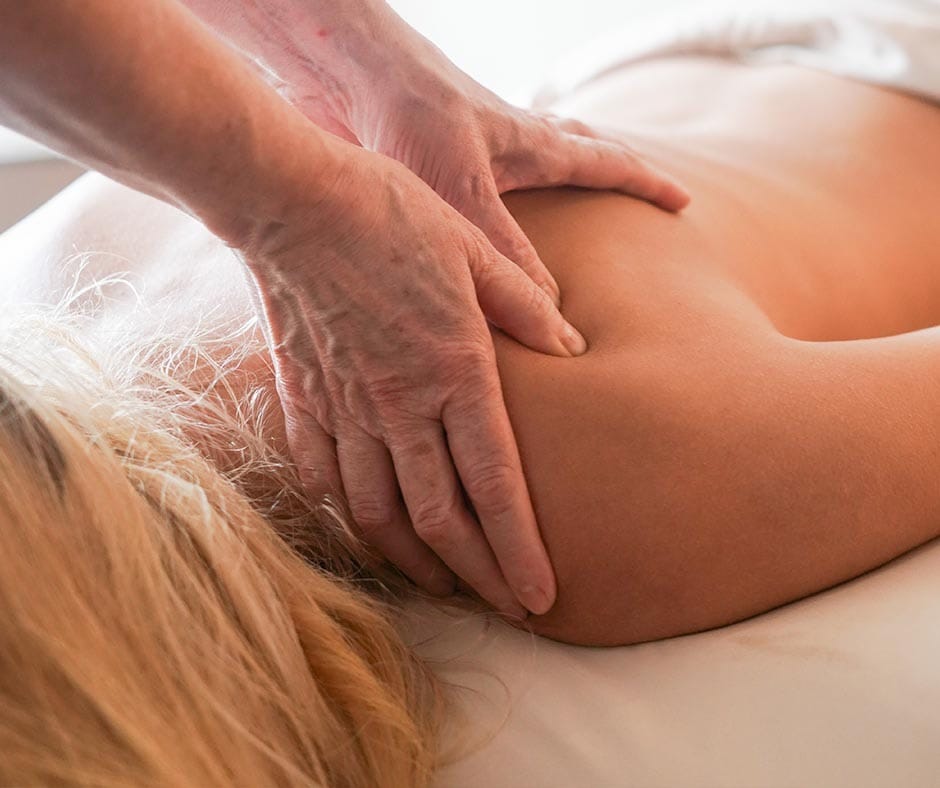
Deep tissue massage uses slow, firm, focused strokes and deep finger pressure to reach the inner layers of your muscles and connective tissue, rather than just working the surface. It isn’t simply a regular massage with more force. It has a specific therapeutic focus, targeting a deeper tissue with a different technique altogether. While there is good research to support it, it may not be the right choice for every type of pain or every situation. Whether it’s the right fit depends less on how much pressure you can handle, and more on what is actually going on in your body, if the tension is old and chronic, or the result of a fresh injury.
At ila Only Spa, our expert therapists take the time to understand what’s actually happening under your skin when a muscle feels “knotted”. They help you figure out whether deep-tissue massage is what you need and recommend something gentler if it’s not.
What a “Knot” Actually Is
A knot is not a literal tangle or bump in the muscle. It is actually a small patch of muscle fibers that stay contracted and can’t relax, often called a trigger point.
These usually form from repeated strain, most often from chronic bad posture. If you lean over a laptop all day, carry a heavy bag on the same shoulder every commute, or lift heavy objects regularly, your muscles are under constant strain, no matter how insignificant the load. Over time, this strain causes micro-inflammation, and the tightened area gets less blood flow and oxygen than it needs. The tissue around it can begin to change, forming disorganized fibers similar to scar tissue. This combination, a tight, under-recovered patch of muscle surrounded by stiffer tissue, is what most people mean when they say they have a “knot.”
How Does a Knot Affect Your Muscles?
This tightened, tangled tissue behaves differently than the healthy muscle around it. It can restrict blood flow, limit your range of motion, and press on nearby nerves, causing a dull, radiating pain that can start to affect your everyday movement.
Can a Deep Tissue Massage Really Help Break Up Muscle Knots?
Deep tissue massage uses slow, firm pressure to reach these deeper layers and help realign the tangled fibers back along the muscle’s natural lines. Over time, this can ease the tightness and restore normal movement to the area.
One study on people with chronic low back pain found deep tissue massage was roughly as effective at reducing pain as common anti-inflammatory medication. It’s also commonly reported to help with sports injuries, plantar fasciitis, tennis elbow, fibromyalgia, sciatica-related pain, and even high blood pressure. None of that requires the massage to hurt; it just requires the right pressure, applied in the right place, by someone who knows what they are doing.
Read on to learn more about deep tissue massage, how it can help you feel better, how it compares to Swedish massage, and what to expect during your session.
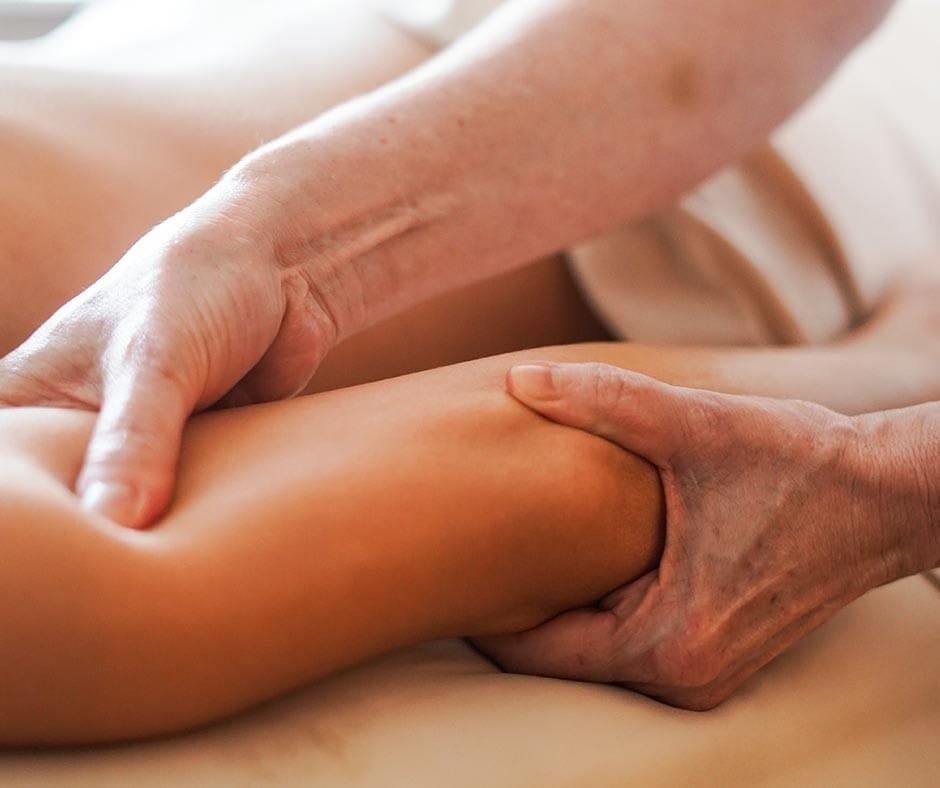
Ready for Deep Tissue? Take This Quick Check First
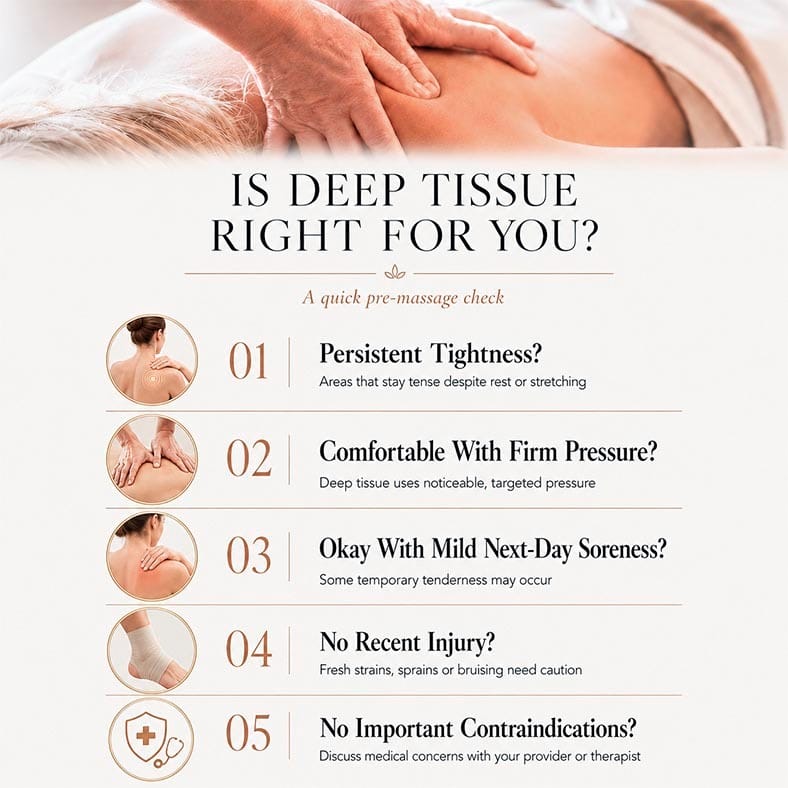
Knowing what deep tissue massage does is one thing. Knowing if it’s the right choice for your body today is another. Chronic tension responds well to deep tissue but a fresh injury, an inflamed joint, or a body that’s simply hoping to unwind does not. It is important to know that pushing deep pressure into the wrong situation can do more harm than good.
Answer “YES” or “NO” to the five questions below to get an idea of where you stand.
- Do you have any sore spots or tight areas that never seem to relax fully, which could be from sitting at a desk all day or from an old injury?
- Are you okay with the therapist using firm, noticeable pressure instead of light, relaxing strokes?
- Would it be fine if you feel a bit sore the next day, something similar to how you would feel after a tough workout?
- Has it been at least 2–3 days since you last strained, sprained, or bruised something? (If nothing like that has happened recently, say yes.)
- Are you free of all of the following: a recent injury, a history of blood clots, bad inflammation, a fever, or blood-thinning medication?
Test Results:
- 5 YES answers – Deep tissue massage is likely a good fit. It will work through deeper layers of chronic tension and should help meaningfully.
- 3–4 YES answers – A gentler option would be better for you, such as a classic Swedish massage or trigger point therapy. Share your particular concerns with your therapist so they can adapt the session to your needs.
- A NO to question 4 or 5 – Deep tissue massage is not for you at this time. Recent injuries or medical contraindications are valid reasons to choose a gentler treatment. Check in with your doctor first.
This information is not a substitute for medical advice. If you are unable to understand the type of pain or soreness you are experiencing, talk to your therapist, and they will adjust your plan based on what your body needs.
Swedish vs. Deep Tissue Massage: What’s the Difference
Deep tissue massage and Swedish massage are two different types of therapy, even though people often use the names interchangeably. Both use some of the same basic strokes, but they are built for different purposes, and the pressure they require varies widely. Each one delivers its own kind of relief, Swedish massage brings full-body relaxation, while deep tissue massage targets deeper tension for lasting relief.
Deep tissue tends to suit people dealing with injuries, chronic pain, or heavy physical activity, such as running or weightlifting. If your pain threshold is lower, or you are mainly looking to ease general muscle tension, Swedish massage is the gentler route.
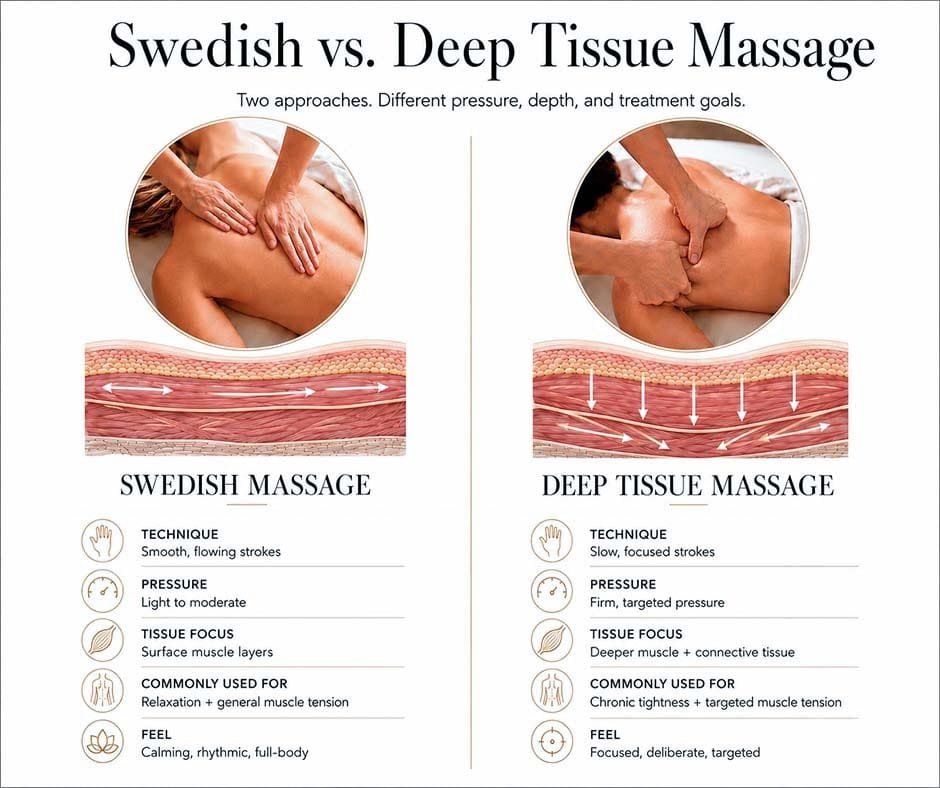
Here’s a side-by-side look at how they differ and what you can expect:
| Swedish Massage | Deep Tissue Massage | |
|---|---|---|
| What it feels like | Smooth, flowing strokes that glide over the skin | Slow, deliberate pressure that sinks into the muscle |
| Main goal | Relaxation and stress relief | Working through tightness and old tension |
| Pressure level | Light to moderate | Firm, sometimes intense |
| Areas it targets | Mostly the top layer of muscle | Deeper muscle and connective tissue |
| Works well for | Unwinding after a stressful week, general tiredness | Chronic tightness, muscle pain, recovery after intense activity |
| The day after | You usually feel loose and refreshed right away | Mild soreness is common, similar to post-workout muscle fatigue |
Want to learn more about the fuller history and technique behind each style? Check out Swedish vs. Deep Tissue Massage.
How Deep Tissue Can Help You Feel Better
The benefits of deep tissue go beyond just the spot that is bothering you. It works on both the body and the mind. When a tight, overworked muscle finally releases, your whole body tends to respond. It feels lighter, moves more easily, and you often sleep better that night.
Enhanced blood flow plays a vital part in this. Tight muscles restrict circulation to the area, which is part of why tension can feel like it lingers no matter how much you stretch. The pressure from a deep-tissue massage helps reopen circulation, pushing blood into areas that have not been receiving a sufficient supply. This can speed up recovery and ease that constant, low-grade stiffness.
The effects of deep tissue massage are not purely physical. Although it focuses more on treating pain than on pure relaxation, most people walk out feeling calmer, as releasing physical tension and pain also relieves mental stress, leaving you relaxed and refreshed.
At ila Only Spa, our therapists know how to bring out these benefits. They use our signature oil blends to make every deep tissue session as soothing as it is therapeutic.
What to Expect During a Deep Tissue Session?
Before the session, your therapist will talk to you about your trouble spots, your general health history, and how much pressure you are comfortable with. Deep tissue can be applied to your whole body or focus on a specific area. You will be asked to lie on a table under a sheet, with only the area being worked on exposed. The therapist will begin with lighter strokes to warm up the muscles before moving into deeper, more targeted kneading and pressure.
Mild soreness for a day or two after the massage is normal, just like after a hard training session or workout, and can usually be eased with a heating pad or a cold pack. Drinking plenty of water afterward can also help your muscles recover. However, if you experience severe pain, call your doctor.
Some Precautions – Important to Know
Because deep tissue uses firm pressure, it is not the right option for everyone.
Check with your healthcare provider before booking a session if you:
- Have a clotting disorder or a history of blood clots
- Have an open wound or skin infection
- Take blood-thinning medication
- Are pregnant
- Have osteoporosis
- Are undergoing cancer treatment such as chemotherapy or radiation
In such cases, gentler types of massage, such as Swedish massage, may be a better option, offering the comfort and relaxation you seek.
Not Sure Which Massage Is Right for You?
At ila Only Spa, our therapists are trained across a full range of techniques, including deep tissue. Whether you are a Midtown professional carrying tension from consecutive meetings, a Wall Street commuter dealing with months of desk posture, or a sportsperson recovering from intense training, we will help you find the massage that actually matches what your body needs.
Get ready to find out how deep tissue massage can benefit you – Book a session at ila Only Spa and give your muscles the focused care they need!